This is default featured slide 1 title

Go to Blogger edit html and find these sentences.Now replace these sentences with your own descriptions.

This is default featured slide 2 title

Go to Blogger edit html and find these sentences.Now replace these sentences with your own descriptions.

This is default featured slide 3 title

Go to Blogger edit html and find these sentences.Now replace these sentences with your own descriptions.

This is default featured slide 4 title

Go to Blogger edit html and find these sentences.Now replace these sentences with your own descriptions.

This is default featured slide 5 title

Go to Blogger edit html and find these sentences.Now replace these sentences with your own descriptions.

First in All Fields


INDIA


Hydroelectric plant - Gaganachukki waterfall ,Sivasamudram Falls, Karnataka. Built in 1902.

City to have electricity-  Bangalore, in 1906  It was in fact the first city in Asia to have electricity.

Man in space -  Rakesh Sharma aboard Salyut 7, on April 3, 1984. He was the 138th man in space worldwide.

Woman in space -Kalpana Chawla  aboard Space Shuttle Columbia flight STS-87, on November 19, 1997. She was a naturalized United States citizen, and represented the US during the event.

Test-tube baby - Durga Agarwal, born 1978

Nuclear Reactor - CIRUS, Mumbai, Maharashtra

Satellite  - Aryabhatta, launched on April 19, 1975

Satellite dedicated exclusively for educational services  -EDUSET

Successfully indigenous launch vehicle - SLV-3


Miss World  - Rita Faria in 1966

Miss Universe - Sushmita Sen in 1994

Booker Prize - Salman Rushdie for Midnight's Children in 1981

Bharat Ratna - Dr. Sarvepalli Radhakrishnan, C. Rajagopalachari, and Dr C.V. Raman in 1954

Chevalier - Sivaji Ganesan

Dadasaheb Phalke Award-Devika Rani in 1969

Ashoka Chakra Award to a civilian - D.K. Jatar (posthumous) and M.C Dixit, captain and co-captain respectively, of the sabotaged plane Kashmir Princess, for "most conspicuous bravery, daring and self-sacrifice"

Magsaysay Award- Vinoba Bhave, 1958

Ford Supermodel of the World - Bipasha Basu, 1996

Rabindranath Tagore for the Nobel Prize in Literature, 1913. He was also the first Asian to get the prize.

Nobel Prize in Physics - C. V. Raman in 1930.

Nobel Prize in Medicine - Har Gobind Khorana in 1968. (India born US citizen)

Nobel Peace Prize- Mother Teresa in 1979 (Albania born Indian citizen)

Nobel Prize in Economics- Amartya Sen in 1998

Person to reach the South Pole - Col Jatinder Kumar Bajaj

Woman to scale Mount Everest - Bachendri Pal on May 23, 1984. She was the 5th woman in the world to scale the peak.

Sound film- Alam Ara, 1931

Oscar winner - Bhanu Athaiya for Best Costume Design for Gandhi (film) in 1982

Oscar nomination for Best Foreign Language Film- Mother India in 1957

first Indian music director who got two oscar- Mr. A. R. Rahman in 2009.

National Film Award for cinema- Shyamchi Aai in 1954

President - Rajendra Prasad (1950-1962)

Vice-President - S. Radhakrishnan

Prime Minister -Jawaharlal Nehru (1947-1964). The first term lasted till 1952 after which he was re-elected

Deputy Prime Minister- Vallabhbhai Patel (1947-1950)

Prime Minister from South India -P. V. Narasimha Rao, 1991

Governor-General -Warren Hastings

Governor General of Independent India -Lord Mountbatten, 1947

Indian Governor-General of Indian Union -C Rajagopalachari, 1948

Chief Justice of India-H. J. Kania (1947-1951)

ICS Officer -Satyendranath Tagore, 1863

Speaker of Lok Sabha -G.V. Mavlankar (1952-1956)

Finance Minister of Independent India- R.K. Shanmukhan Chetty (1947-1949)

WOMEN

Prime Minister- Indira Gandhi, 1966

Minister in a government- Rajkumari Amrit Kaur in the Ministry of Health

Chief Minister of a State -Sucheta Kripalani, Chief Minister of Uttar Pradesh, 1963-1967

Governor - Sarojini Naidu, Governor of Uttar Pradesh, 1947-1949

Speaker of the Lok Sabha- Meira Kumar

Indian National Congress President - Annie Besant

President - Pratibha Patil, 2007

IPS Officer- Kiran Bedi

FATHER'S OF DIFFERENT FIELDS

FATHER'S OF DIFFERENT FIELDS
  •  Father of modern chemistry is Jabir bin Hayyan
  •  Father of botany is Theofrastus
  •  Father of biology is Aristotle
  •  James Hutton is called the father of modern geology.
  •  Father of Homeopathy is Heinemann.
  •  Founder of physical chemistry Arrhenius.
  •  Copernicus is known as the Father of Astronomy.
  •  Greek writer Herodotus is called father of History.
  •  Father of English poetry - 1340 - 1400 Geoffrey   Chaucer
  •  Aristophanes is called father of comedy.
  •  Charles babbage is called " Father of computer "
  •  Adam smith is called " Father of economics "

Indian Nobel Prize Winners

Indian Nobel Prize Winners

RABINDRANATH TAGORE (1913) - Literature:
  • Popularly known as Gurudev born in Kolkatta. He was a Bengali poet, philosopher, playwright, composer, and novelist.
  • India's most famous writer and poet was awarded the Nobel Prize in recognition of his work Geetanjali, a collection of poems, in 1913.
  • In 1901 he founded the famous Santiniketan which later came to be known as Vishwabharati University.
  • Rabindranath Tagore was the first non-European and first Asian to be awarded the Nobel Prize in Literature. His elegant prose and magical poetry mesmerized millions.
  • Tagore's major works included Gitanjali, Gora, and Ghare-Baire. Two of his songs are now the national anthems of Bangladesh and India, i.e. the Amar Shonar Bangle and the Jana Gone Mona, respectively.
CHANDRASHEKAR VENKATA RAMAN (1930) - Physics:
  • Born at Thiruvanaikkaval in Tamil Nadu, Raman studied at Presidency College, Madras. Later, he served as Professor of Physics at Calcutta University.
  • C.V. Raman won the Nobel Prize for an important research in the field of optics (light). Raman had found that diffused light contained rays of other wavelengths-what is now popularly known as Raman Effect. Raman had found that diffused light contained rays of other wavelengths-what is now popularly known as Raman Effect.
  • His theory explains why the frequency of light passing through a transparent medium changes, while some of the light that emerges at a right angle to the original beam is of other frequencies (Raman frequencies) characteristic of the material.
  • He is known for his extensive work in the field of acoustics and light. He even studied the physiology of the human eye.
HARGOBIND KHORANA (1968) - Medicine:
  • Nobel Prize for Medicine in 1968 for his study of the Human Genetic Code and its role in Protein Synthesis.
  • Dr. Khorana was born in Raipur, Punjab (now in Pakistan). He went abroad to get his doctorate in Chemistry and later settled there.
  • He continued to head a laboratory at the Massachusetts Institute of Technology (MIT) in the United States, until his death in 2011.
  • He shared a 1968 Nobel Prize with M. W. Nirenberg and R. W. Holley for research that helped show how the cell nucleus controls the synthesis of proteins. In 1970 he prepared the first artificial copy of a yeast gene.
MOTHER TERESA (1979) - Peace Prize:
  • She was awarded Nobel Prize for Peace in 1979, for her service through her Charitable Mission “Nirmal Hriday” at Calcutta to people suffering from Leprosy and to those people dying in destitute.
  • Mother Teresa was born in Yugoslavia. She wanted to become a nun and joined the Irish order of the Sisters of Loretto (at Dublin) in 1928. It is as a nun that Agnes came Calcutta in 1929. 
  • Here she was extremely touched by the misery of the poor and the sick. She decided to dedicate her life to serving them. She then founded a group of similar minded people called the Missionaries of Charity and set up Nirmal Hriday a center where she took care of the dying, the lepers and other people who had been left alone on the streets of Calcutta to die.
Dr. SUBRAMANIAN CHANDRASHEKAR (1983) - Physics:
  • Dr. Chandrashekar, is an Indian-born astrophysicist, is the nephew of another Nobel Prize winner Sir C.V. Raman. Subramanyam Chandrasekhar was awarded Nobel Prize in Physics in the year 1983 for his theoretical studies of the structure and evolution of the stars. 
  • He determined that star cluster dynamics were similar in nature to the Brownian motion of particles suspended in liquids.
  • He reported that following its red giant phase, a star with a remaining mass greater than 1.4 times that of the Sun (the Chandrasekhar limit) collapses and becomes a neutron star during a supernova explosion. 
  • Stellar remnants more massive than about three solar masses collapse even further to become black holes. He shared a 1983 Nobel Prize with W. A. Fowler. He has written many books on his field Astrophysics and
  • Stellar Dynamics. He developed a theory on white dwarf stars forecasts the limit of mass that dwarf stars can have. This limit is known as the Chandrashekar Limit. 
  • His theory also explains the final stages of the evolution of stars.
AMARTYA SEN (1998) - Economics:
  • Prof. Amartya Sen is the first Asian to win the Economics Nobel. He is one of the most respected economics thinker in the world. He is also an excellent teacher. He won the Nobel for his work in the area of economic theory. Some of his most important work is in the areas of poverty, democracy, development and social welfare.
  • He was born at Santiniketan, India. Sen is best known for his work on the causes of famine, and his research led to the development of solutions for limiting the effects of food shortages.
  • He wrote Poverty and Famines: An Essay on Entitlement and Deprivation (1981) which showed that declining wages, unemployment, rising food prices, and inefficient food distribution could lead to starvation.
Dr.Venkataraman Ramakrishnan-2009:
  • Dr.Venkataraman Ramakrishnan, an Indo-American has shared Nobel Prize for Chemistry for the year 2009, along with a co-American Thomas Steitz and Ada Yonath of Israel for mapping ribosomes, the protein procuring factories within cells at the atomic level.
Mr. Kailash Satyarthi -2014
  • Mr.Kailash Satyarthi, an Indian Children's rights activist had been awarded the "Nobel Prize For Peace" for the year 2014, jointly with Ms.Malala Yousafzai of Pakistan (17 years old Children's rights activist of Pakistan) for their struggle against the suppression of children and young people and for the right of all children to education.
 Nobel Prize has been given for the works related to India:-
 
Rudyard Kipling-1907:
  • A British Poet has been awarded Nobel Prize for Literature (1907) for his works in Literature such as Poems and Short Stories related to India and Burma/ Myanmar.
Vidiadhar Surajprasad Naipaul-2001:
  •  A British Writer of Indian Origin was awarded Nobel Prize for Literature in 2001.

FIVE YEAR PLANS OF INDIA


FIVE YEAR PLANS OF INDIA

Derived from russia (then USSR)

12 Five year plan launched so far.
12 Five year plan will be the last five year plan because since 2017 the government of (NITI) Aayug has decided to stop launching of five year plan in India.

FIRST FIVE YEAR PLAN:
  • Jawahar lal nehru presented the first plan to the parliament on december8 1951- 1956.
  • "Harrod - 'Domar " model"
  • Agricultural development at the country.
  • 3.6% grouth rate. 
SECOND FIVE YEAR PLAN:
  • 1956-1961.
  • Based on "P.C Mahalanobis model".
  • Focus was Industrial development.
  • 4.1% growth rate
THIRD FIVE YEAR PLAN:
  • 1961-1966.
  • Called "Godgil yojina".
  • Economy Independent.
  • Due to china war would not achieve the grouth rate target of 5.6%
PLAN HOLIDAY:
  • 1966-1969.
  • ]Reason behind their was.
  • India pakistan war and failure of 3rd five year plan.
FOURTH FIVE YEAR PLAN:
  • 1969-1974
  • Grouth eith stebility and self reliance.
  • Slogan "GARRIBI HATAO".
  • During 1971 elections by indira gandhi 
  • 3.3% growth
FIFTH FIVE YEAR PLAN 
  • 1974-1979.
  • Agriculture.
  • 4.8% growth
  • Dhar plan terminated in 1978 Rolling plan : 1978-78
SIXTH FIVE YEAR PLAN:
  • 1980-1985
  • Poverty eradication and technological self reliance.
  • 5.7% growth
SEVENTH FIVE YEAR PLAN:
  • 1985-1990.
  • Suffucient economy, productive employment.
  • Private sets got priority over publisector.
  • 6.0% growth rate
EIGHT FIVE YEAR PLAN :
  • 1992-1997
  • Development of human resources.
  • Narasimharao
  • 5.6% growth rate
NINTH FIVE YEAR PLAN:
  • 1997-2002
  • Grouth with justice and equlity.
  • 50th year of indipendence of india.
  • 5.6% growth rate
TENTH FUVE YEAR PLAN :
  • 2002-2007.
  • Double per capita income.
  • Poverty.
  • 7.2% growth rate
ELEVENTH FIVE YEAR PLAN:
  • 2007-2012
  • C.Rangarajan
  • "Faster and morinclusive growth.
  • 7.9% growth rate
TWELTTH FIVE YEAR PLAN :
  • 2012-2017
  • "Fast and more inclusive and substainble grouth "
  • 8% growth    

GALILEO GALILEI

GALILEO GALILEI

Galileo Galilei was born on 15February 1564 in italy. Galileo has been called the "Father of modern science". In 1589,in his series of essays, he presented his theories about falling objets using an inclined plane to show down the rate of decent.

Galileo was also remarkble craftsman. He developed a series of telescope whose optical performance was much better than that of other telescopes availble during hos days

Around 1640, he designed the first Pendulam clock. In his book" Satrry Messenger" on his astronomical discoviries, Galileo claimed to have seen mountains on the moon, the milky way made up of tiny stars, and foursmall bodies orbiting disclosedhis observation of sun spots 

Using his  Own telescopes and through his observation on satrun and venus Galileo argued that all the plants must orbit the sun and not the earth country what was believed at the time.                                                      

Oppurtunities for Electrical Engineers after BTECH

Indian Engineering Service

The UPSC Board for recruitment conducts the Indian Engineering Service (IES) examination for recruiting engineers into various government departments.The recruitment process involves two step- written examination and personality test. The written examination carries 1000 marks and comprises five papers. Paper -I is the general ability test, which assesses the candidate’s competence in English and General Studies.It carries 200 marks. Paper II and III carry questions from the relevant engineering subject and carry 200 marks each. Papers I, II and III are objective type. Papers- IV and V are conventional type and carry 200 marks each. They deal with the relevant discipline of engineering.Personality Test carries 200 marks. It aims at assessing qualities like leadership qualities, social skills, zeal to learn and mental fitness.

Research Organizations

Research organizations like the Indian Space Research Organization, Defence Research and Development Organization and Vikram Sarabhai Space Centre hire engineering graduates for various job roles. The minimum eligibility criterion for most of them is at least 65 per cent marks in BE/ B.Tech. Candidates are short-listed for written test and interview, based on their academic record and GATE score. Since a candidate is allowed to appear in ONLY ONE of the 23 papers for which GATE 2018 examination is being held, the candidate has to make the choice of the paper he/she wishes to write carefully.In all the papers, there will be a total of 65 questions carrying 100 marks, out of which 10 questions carrying a total of 15 marks are in General Aptitude (GA).

Electricity Boards 

Electricity boards of various States hire engineers for posts like Assistant Engineer. Selection is based on performance at entrance test.

private sector


Allen Bradley, Siemens, Modicon , GE Fanuc ,General motors etc

GA-7


2019  Andhra Pradesh Ministers

Chief Minister of Andhra pradesh                        : N.  Chandra Babu Naidu

Deputy of Chief Minister of Andhra Pradesh       : S. krishna Murthy

Home Minister of Andhra Pradesh                       : N .Rajapa

Finance Minister of  Andhra Pradesh                    :  Yanamala Ram krishnudu

Rural development IT communication                  : Nara lokesh

Transport minister of anf Andhra pradesh             : K. Atchannaidu

Mines and geology minister of Andhra pradesh    : Sujay krishna rangarao

Roads and building minister of Andhra pradesh    : C.H Ayyanapatrudu

Education minister  of Andhra pradesh                  : S.G Srinivas Rao

Water resources management                                 : Devininani uma maheswarao

Municipal administration and  urban development :Dr .P. Narayana

GATE SYLLABUS EE 2019

Engineering Mathematics

Linear Algebra


Matrix Algebra, Systems of linear equations, Eigenvalues, Eigenvectors.

Calculus

Mean value theorems, Theorems of integral calculus, Evaluation of definite and improper integrals, Partial Derivatives, Maxima and minima, Multiple integrals, Fourier series, Vector identities, Directional derivatives, Line integral, Surface integral, Volume integral, Stokes’s theorem, Gauss’s theorem, Green’s theorem.


Differential equations

First order equations (linear and nonlinear), Higher order linear differential equations with constant coefficients, Method of variation of parameters,Cauchy’s equation, Euler’s equation, Initial and boundary value problems, Partial Differential Equations, Method of separation of variables.

Complex variables

Analytic functions, Cauchy’s integral theorem, Cauchy’s integral formula, Taylor series, Laurent series, Residue theorem, Solution integrals.

Probability and Statistics

Sampling theorems, Conditional probability, Mean, Median,Mode, Standard Deviation, Random variables, Discrete and Continuous distributions, Poisson distribution, Normal distribution, Binomial distribution, Correlation analysis, Regression analysis.

Numerical Methods

Solutions of nonlinear algebraic equations, Single and Multi‐step methods for differential equations.

Transform Theory

Fourier Transform, Laplace Transform, z‐Transform.

Electrical Engineering


Electric Circuits

Network graph, KCL, KVL, Node and Mesh analysis, Transient response of dc and ac networks, Sinusoidal steady‐state analysis, Resonance, Passive filters, Ideal current and voltage sources, Thevenin’s theorem, Norton’s theorem, Superposition theorem, Maximum power transfer theorem, Two‐port networks, Three phase circuits, Power and power factor in ac circuits.

Electromagnetic Fields

Coulomb's Law, Electric Field Intensity, Electric Flux Density, Gauss's Law, Divergence, Electric field and potential due to point, line, plane and spherical charge distributions, Effect of dielectric medium, Capacitance of simple configurations, Biot‐Savart’s law, Ampere’s law, Curl, Faraday’s law, Lorentz force, Inductance, Magnetomotive force, Reluctance, Magnetic circuits,Self and Mutual inductance of simple configurations.

Signals and Systems

Representation of continuous and discrete‐time signals, Shifting and scaling operations, Linear Time Invariant and Causal systems, Fourier series representation of continuous periodic signals, Sampling theorem, Applications of Fourier Transform, Laplace Transform and z-Transform.

Electrical Machines

Single phase transformer 

Equivalent circuit, phasor diagram, open circuit and short circuit tests, regulation and efficiency; Three phase transformers: connections, parallel operation; Auto‐transformer, Electromechanical energy conversion principles, DC machines: separately excited, series and shunt, motoring and generating mode of operation and their characteristics, starting and speed control of dc motors.

Three phase induction motors

Principle of operation, types, performance, torque-speed characteristics, no-load and blocked rotor tests, equivalent circuit, starting and speed control; Operating principle of single phase induction motors

Synchronous machines

Cylindrical and salient pole machines, performance ,regulation and parallel operation of generators, starting of synchronous motor, characteristics; Types of losses and efficiency calculations of electric machines.

Power Systems

Power generation concepts, ac and dc transmission concepts, Models and performance of transmission lines and cables, Series and shunt compensation, Electric field distribution and insulators, Distribution systems, Per‐unit quantities, Bus admittance matrix, Gauss-Seidel and Newton-Raphson load flow methods, Voltage and Frequency control, Power factor correction, Symmetrical components, Symmetrical and unsymmetrical fault analysis, Principles of over‐current, differential and distance protection; Circuit breakers,System stability concepts, Equal area criterion.

Control Systems


Mathematical modeling and representation of systems, Feedback principle, transfer function, Block diagrams and Signal flow graphs, Transient and Steady‐state analysis of linear time invariant systems, Routh-Hurwitz and Nyquist criteria, Bode plots, Root loci, Stability analysis, Lag, Lead and Lead‐Lag compensators; P, PI and PID controllers; State space model, State transition matrix.


Electrical and Electronic Measurements

Bridges and Potentiometers, Measurement of voltage, current, power, energy and power factor; Instrument transformers, Digital voltmeters and multimeters, Phase, Time and Frequency measurement; Oscilloscopes, Error analysis.

Analog and Digital Electronics

Characteristics of diodes, BJT, MOSFET; Simple diode circuits: clipping, clamping, rectifiers;Amplifiers: Biasing, Equivalent circuit and Frequency response; Oscillators and Feedback amplifiers; Operational amplifiers: Characteristics and applications; Simple active filters, VCOs and Timers, Combinational and Sequential logic circuits, Multiplexer, Demultiplexer,Schmitt trigger, Sample and hold circuits, A/D and D/A converters.

8085Microprocessor:

Architecture, Programming and Interfacing.

Power Electronics

Characteristics of semiconductor power devices: Diode, Thyristor, Triac, GTO, MOSFET, IGBT; DC to DC conversion: Buck, Boost and Buck-Boost converters; Single and three phase configuration of uncontrolled rectifiers, Line commutated thyristor based converters, Bidirectional ac to dc voltage source converters, Issues of line current harmonics, Power factor, Distortion factor of ac to dc converters, Single phase and three phase inverters, Sinusoidal pulse width modulation.

ESE or IES SYLLABUS EEE

UPSC Syllabus for Electrical Engineering Service (ESE) 

APTITUDE PAPER (Stage-I, Paper-I):


General Studies and Engineering Aptitude

(Stage I – Paper I, Objective type, Common to all Candidates, 2 hours duration, 200 Marks maximum)

The questions from the following Topics will be set in Paper-I of Stage-I

1. Current issues of national and international importance relating to social, economic and industrial development

2. Engineering Aptitude covering Logical reasoning and Analytical ability

3. Engineering Mathematics and Numerical Analysis

4. General Principles of Design, Drawing, Importance of Safety

5. Standards and Quality practices in production, construction, maintenance and services

6. Basics of Energy and Environment : Conservation, environmental pollution and degradation, Climate Change, Environmental impact assessment

7. Basics of Project Management

8. Basics of Material Science and Engineering

9. Information and Communication Technologies (ICT) based tools and their applications in Engineering such as networking, e-governance and technology based education.

10. Ethics and values in Engineering profession

Note: The paper in General Studies and Engineering Aptitude will include Knowledge of relevant topics as may be expected from an engineering graduate, without special study. Questions from all the 10 topics mentioned above shall be set. Marks for each Topic may range from 5% to 15% of the total marks in the paper.

Electrical Engineering

Contents for syllabus of both the Papers together for Stage-I objective type Paper–II and separately for Stage-II Conventional type Paper-I and Paper – II

PAPER – I

1. Engineering Mathematics

Matrix theory, Eigen values & Eigen vectors, system of linear equations, Numerical methods for solution of non-linear algebraic equations and differential equations, integral calculus, partial derivatives, maxima and minima, Line, Surface and Volume Integrals. Fourier series, linear, nonlinear and partial differential equations, initial and boundary value problems, complex variables, Taylor’s and Laurent’s series, residue theorem, probability and statistics fundamentals, Sampling theorem, random variables, Normal and Poisson distributions, correlation and regression analysis. 


2.Electrical Materials

Electrical Engineering Materials, crystal structures and defects, ceramic materials, insulating materials, magnetic materials – basics, properties and applications; ferrities, ferro-magnetic materials and components; basics of solid state physics, conductors; Photo-conductivity; Basics of Nano materials and Superconductors.


3. Electric Circuits and Fields

Circuit elements, network graph, KCL, KVL, Node and Mesh analysis, ideal current and voltage sources, Thevenin’s, Norton’s, Superposition and Maximum Power Transfer theorems, transient response of DC and AC networks, Sinusoidal steady state analysis, basic filter concepts, two-port networks, three phase circuits, Magnetically coupled circuits, Gauss Theorem, electric field and potential due to point, line, plane and spherical charge distributions, Ampere’s and Biot-Savart’s laws; inductance, dielectrics, capacitance; Maxwell’s equations.

4. Electrical and Electronic Measurements


Principles of measurement, accuracy, precision and standards; Bridges and potentiometers; moving coil, moving iron, dynamometer and induction type instruments, measurement of voltage, current, power, energy and power factor, instrument transformers, digital voltmeters and multi-meters, phase, time and frequency measurement, Q-meters, oscilloscopes, potentiometric recorders, error analysis, Basics of sensors, Transducers, basics of data acquisition systems

5. Computer Fundamentals

Number systems, Boolean algebra, arithmetic functions, Basic Architecture, Central Processing Unit, I/O and Memory Organisation; peripheral devices, data represenation and programming, basics of Operating system and networking, virtual memory, file systems; Elements of programming languages, typical examples.

6. Basic Electronics Engineering

Basics of Semiconductor diodes and transistors and characteristics, Junction and field effect transistors (BJT, FET and MOSFETS), different types of transistor amplifiers, equivalent circuits and frequency response; oscillators and other circuits, feedback amplifiers.

PAPER – II

1. Analog and Digital Electronics

Operational amplifiers – characteristics and applications, combinational and sequential logic circuits, multiplexers, multi-vibrators, sample and hold circuits, A/D and D/A converters, basics of filter circuits and applications, simple active filters; Microprocessor basics- interfaces and applications, basics of linear integrated circuits; Analog communication basics, Modulation and demodulation, noise and bandwidth, transmitters and receivers, signal to noise ratio, digital communication basics, sampling, quantizing, coding, frequency and time domain multiplexing, power line carrier communication systems. 


2.Systems and Signal Processing 


Representation of continuous and discrete-time signals, shifting and scaling operations, linear, time-invariant and causal systems, Fourier series representation of continuous periodic signals, sampling theorem, Fourier and Laplace transforms, Z transforms, Discrete Fourier transform, FFT, linear convolution, discrete cosine transform, FIR filter, IIR filter, bilinear transformation.

3. Control Systems


Principles of feedback, transfer function, block diagrams and signal flow graphs, steady-state errors, transforms and their applications; Routh-hurwitz criterion, Nyquist techniques, Bode plots, root loci, lag, lead and lead-lag compensation, stability analysis, transient and frequency response analysis, state space model, state transition matrix, controllability and observability, linear state variable feedback, PID and industrial controllers.


4. Electrical Machines 

Single phase transformers, three phase transformers – connections, parallel operation, auto-transformer, energy conversion principles, DC machines – types, windings, generator characteristics, armature reaction and commutation, starting and speed control of motors, Induction motors – principles, types, performance characteristics, starting and speed control, Synchronous machines – performance, regulation, parallel operation of generators, motor starting, characteristics and applications, servo and stepper motors.

5. Power Systems 

Basic power generation concepts, steam, gas and water turbines, transmission line models and performance, cable performance, insulation, corona and radio interference, power factor correction, symmetrical components, fault analysis, principles of protection systems, basics of solid state relays and digital protection; Circuit breakers, Radial and ring-main distribution systems, Matrix representation of power systems, load flow analysis, voltage control and economic operation, System stability concepts, Swing curves and equal area criterion. HVDC transmission and FACTS concepts, Concepts of power system dynamics, distributed generation, solar and wind power, smart grid concepts, environmental implications, fundamentals of power economics.

6. Power Electronics and Drives 

Semiconductor power diodes, transistors, thyristors, triacs, GTOs, MOSFETs and IGBTs – static characteristics and principles of operation, triggering circuits, phase control rectifiers, bridge converters – fully controlled and half controlled, principles of choppers and inverters, basis concepts of adjustable speed dc and ac drives, DC-DC switched mode converters, DC-AC switched mode converters, resonant converters, high frequency inductors and transformers, power supplies. 

Syllabus for Assistant Engineer Electrical

 ASSISTANT ENGINEER -ELECTRICAL


1.Electrical Circuits: 
KVl, KCl, node and mesh analysis, star/delta transformation, electromagnetic induction, mutual induction, ac fundamentals, transient response of dc and ac networks,sinusoidal steady state analysis, resonance, ideal current and voltage sources, Network theorems, two-port networks, three phase circuits, power measurement in 3-phase circuits.


2. Electrical Measurements: 
Bridges and potentio meters, PMMC, moving coil, moving iron,dynamometer, induction type measuring instruments, measurement of voltage, current, power,

energy, power factor, digital volt meters, multi-meters, ,phase, frequency measurements, Qmeters,oscilloscopes


3. Control Sytems:
Principles of feedback control systems, transfer function, block diagram reduction,signal flow graph, Mason's,gain formula,time response, steady state error,Routh ,Nyquist criterion, Bode plot, root locus, compensation design

4. Analog and digital electronics: 
Chacteristics of p-n diode, Zener diode, BJT, FET, amplifiers,biasing, low frequency and high frequency equivalent circuits, frequency response, feedback amplifiers, oscillators, combinational and sequential logic circuits, multiplexer, Schmitt trigger, A/D, D/A converters, basics of 8-bit, 16 bit microprocessors, architecture, programming,interfacing

5. Electrical Machines: 
Single phase transformer, equivalent circuit, phasor diagram,tests,regulation, efficiency,3-phase transformers, connections, parallel operation,autotransformer,

DC machines: types, armature windings,characterstics of dc generators and motors, armature reaction, commutation,starting and speed control of dc motors 

3-phase induction motors: 

Principle of operation, types, characteristics, computation of performance, equivalent circuit, starting and speed control

Single phase induction motors:
Types, methods of starting, characteristics Synchronous Machines:emf equation, armature reaction, equivalent circuit, regulation, parallel operation, load sharing, operation with infinite busbars, synchronous motor, synchronous condensor, V and Inverted V curves


6. Power Systems: 

Basic power generation concepts, transmission line models and performace,Under ground cables, string insulators, corona, distribution systems, per unit quantities, bus impedance and admittance matrices, load flow studies, voltage control, power factor correction,economic operation, symmetrical components, fault analysis, principles of over current, differential, and distance protection, protection of alternators, protection of transformers,proection of transmission lines, protection from lightning, neutral grounding, circuit breakers,types and operation of CBs, system stability concept, swing curves, equal area criterion

7. Utilization: 
Electric heating, resistance heating, induction heating, dielectric heating, Electric

traction, lighting calculations, types of lamps and their working

8. Power Electronics and Drives:
 
SCR, IGBT, MOSFET, static and dynamic characteristics, triggering circuits, phase control rectifiers, bridge rectifiers, principles of de-de converters, Inverters, basic principles and characteristics of adjustable speed dc and ac drives


                                         Instructions 
• The question paper consists of 100 multiple choice questions

• The answer are to be marked on separate OMR answer sheet using blue or back ball point

pen.The answer can not be erased once it is marked. Use of white correction fluid is strictly

prohibited.

• The duration of the test is 2hrs (120 minutes)

List of Prime Ministers of India


1.Jawaharlal Nehru
  • Tenure:Aug. 15, 1947 – May 27, 1964 
  • Born: 14 November 1889 
  • Place of Birth: Allahabad 
  • Parents: Motilal Nehru (father) and Swaruprani Thussu (mother) 
  • Spouse: Kamala Nehru 
  • Children: Indira Gandhi 
  • Party : Congress 
  • Award : Bharata RatnaFirst PM who introduced budget . 
  • Publications: The Discovery of India, Glimpses of World History, Toward Freedom, Letters from a Father to His Daughter 
  • Passed Away: 27 May 1964 
  • Memorial: Shantivan, New DelhiTenure 
Gulzarilal Nanda 
  • Tenure : May 27, 1964 – June 9, 1964 (Interim) 
  • Party : Congress 
2. Lal Bahadur Shastri
  • Tenure:June 9, 1964 – January 11, 1966 
  • Born: 2 October 1904 
  • Party : Congress 
  • Award : Bharata Ratna 
  • Slogan : Jai Jawan Jai kisan in 1965 at a public gathering at Ramlila Maidan, Delhi. 
  • He is also known as Indian Lincoln 
  • Place of Birth: Mughalsarai, Varanasi, Uttar Pradesh 
  • Parents: Sharada Prasad Shrivastava (Father) and Ramdulari Devi (Mother) 
  • Wife: Lalita Devi 
  • Children: Kusum, Hari Krishna, Suman, Anil, Sunil and Ashok 
  • Movement: Indian Independence Movement 
  • Passed Away: 11 January 1966 
  • Memorial: Vijay Ghat, New DelhiTenure 
Gulzarilal Nanda
  • Tenure : January 11 – 24, 1966(Interim) 
  • Party : Congress 
3. Indira Gandhi
  • Tenure : Jan. 24, 1966 to March 24, 1977 and Jan. 14, 1980 to Oct. 31,1984
  • Party : Congress 
  • Award : Bharata Ratna 
  • Slogan : Garibi Hatao desh bachao ("Abolish poverty, save the nation") in 1971 
  • Date of Birth : 19 November 1917 
  • Place of Birth : Allahabad, Uttar Pradesh 
  • Parents : Jawaharlal Nehru (father) and Kamala Nehru (mother) 
  • Spouse : Feroze Gandhi 
  • Children : Rajiv Gandhi and Sanjay Gandhi 
  • Movement : Indian Independence Movement 
  • Political Ideology : Right winged, Liberal 
  • Publications : My Truth (1980), Eternal India (1981) 
  • Passed Away : 31 October 1984 
4.Morarji Desai 
  • Tenure : March 24, 1977 to July 28, 1979 
  • Party : Janata Party 
  • Award : Bharata Ratna 
  • 5.Charan Singh 
  • Tenure :July 28, 1979 – Jan. 14, 1980 
  • Party : Janata Party 
  • His birthday on 23 December is celebrated as Kisan Diwas in India 
6.Rajiv Gandhi
  • Tenure : Oct. 31,1984 to Dec. 1,1989 
  • Party : Congress 
  • Slogan : Garibi Hatao desh bachao ("Abolish poverty, save the nation") 
  • Award : Bharata Ratna 
  • Publications: Rajiv's World: Photographs by Rajiv Gandhi (1995) 
  • Place of death: Sriperumbudur, Tamil Nadu 
  • Memorial: Rajiv Gandhi Memorial, Sriperumbudur, Tamil Nadu 
7.V.P.Singh(Vishwanath Pratap Singh)
  • Tenure : Dec. 2,1989 – Nov. 10, 1990 
  • Party : Janata Dal 
8.Chandra Sekhar
  • Tenure : Nov. 10,1990 – June 21, 1991 
  • Party : Janata Dal 
  • Born: 1 July 1927, Ibrahimpatti 
  • Died: 8 July 2007, Apollo Hospital, Indraprastha 
  • Books: Dynamics of Social Change, Meri Jail Diary- I, MORE 
  • Children: Neeraj Shekhar 
9.P.V.Narasimha Rao(Pamulaparti Venkata Narasimha Rao)
  • Tenure : June 21, 1991 to May 10, 1996 
  • Party : Congress 
  • Born: 28 June 1921, Laknepalli 
  • Died: 23 December 2004, New Delhi 
  • Publications: The insider,Antargatha 
10.Atal Bihari Vajpayee
  • Tenure : May 16 to June 1, 1996 and March 19, 1998 – May 22, 2004 
  • Party : Bharatiya Janata Party 
  • Born: 25 December 1924 , Gwalior 
  • Awards: Bharat Ratna, Padma Vibhushan 
  • Publications: 21 poems,Decisive days 
11.H.D.Deve Gowda(Haradanahalli Doddegowda Deve Gowda)
  • Tenure : June 1, 1996 to April 21, 1997 
  • Party : Janata Dal 
  • Born: 18 May 1933 , Haradanahalli 
  • He was serving as the 14th Chief Minister of Karnataka from 1994 to 1996. 
12. I.K.Gujral
  • Tenure : April 21, 1997 – Nov. 28. 1997 
  • Party : Janata Dal 
13.Man Mohan Singh
  • Tenure :May 22, 2004 - May 17 2014 
  • Party : Indian National Congress 
  • Born: 26 September 1932 (age 85), Gah, Pakistan 
  • Publications: In Ghost Den 
14.Narendra Modi
  • Tenure :26th May of 2014 to till date 
  • Party : Bharatiya Janata Party 
  • Born: 17 September 1950 ,Vadnagar, Bombay State, India 
  • Publications: Social Harmony,A Journey:Poems 
  • He is the 16th and current Prime Minister of India 


Initial value and Final value theorem


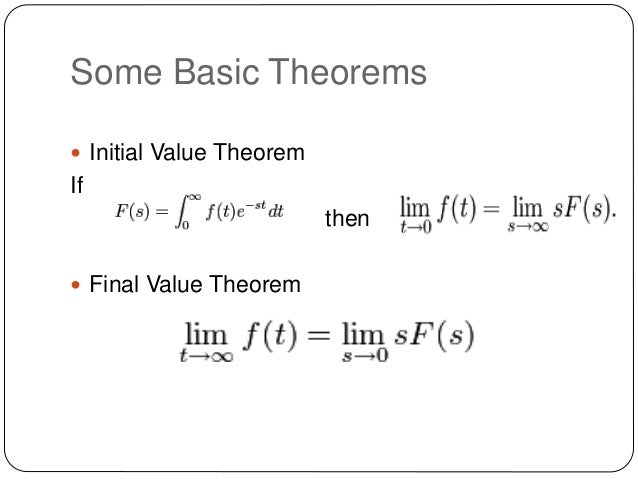
Initial value theorem:


If f(t) and F(s) is Laplace transform pairs. i.e


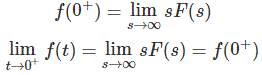
then Initial value theorem is given by


Final value theorem:


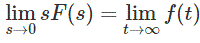
If f(t) and f'(t) both are Laplace Transformable and sF(s) has no pole in jw axis

and in the R.H.P. i.e Right half Plane then,


                                                           = f(infinite)


ACTIVE,REACTIVE,APPARENT AND COMPLEX POWER


REAL POWER: 
Real Power is the actual power which is really transferred to the load such as motors,transformers etc.,
Alternative words used for Real Power (Actual Power, True Power, Watt-full Power, Useful Power, Real Power, and Active Power) and denoted by (P) and measured in units of Watts (W) i.e. The unit of Active or Real power is Watt where 1W = 1V x 1 A.

Real Power in DC Circuits:
In DC Circuits, power supply to the DC load is simply the product of Voltage across the load and Current flowing through it i.e., P = V I because in DC Circuits, there is no concept of phase angle between current and voltage. In other words, there is no frequency (f) or powe factor in DC Circuits.
Real Power in AC Circuits:

But the situation in Sinusoidal or AC Circuits is more complex because of phase difference (θ) between Current and Voltage. Therefore average value of power (Real Power) is P = VI Cosθ is in fact supplied to the load.

Real Power formulas:
P = V I (In DC circuits)
P = VI Cosθ (in Single phase AC Circuits)
P = √3 VL IL Cosθ or (in Three Phase AC Circuits)
P = 3 VPh IPh Cosθ

Reactive Power: (Q) 

It is also  known as (Use-less Power, Watt less Power)

Power merely absorbed and returned in load due to its reactive properties is referred to as reactive power. denoted by Q

Reactive power represent that the energy is first stored and then released in the form of magnetic field or electrostatic field in case of inductor and capacitor respectively.

Reactive power is given by Q = V I Sinθ which can be positive (+ve) for inductive loads and negative (-Ve) for capacitive load.

The unit of reactive power is Volt-Ampere reactive i.e. VAR where 1 VAR = 1V x 1A.
In Inductor or Capacitor, how much magnetic or electric field made by 1A x 1V is called the unit of reactive power.


Apparent Power: (S)

The combination of reactive power and true power is called apparent power

In an AC circuit, the product of the r.m.s voltage and the r.m.s current is called apparent power which is denoted by (S) and measured in units of Volt-amp (VA).
S=V*I

It is the product of Voltage and Current without phase angle.

The unit of Apparent power (S) VA i.e. 1VA = 1V x 1A.

When the circuit is pure resistive, then apparent power is equal to real or true power, but in inductive or capacitive circuit, (when Reactances exist) then apparent power is greater than real or true power.


Complex Power: (S )

The Complex sum of Real Power (P) and Reactive Power (Q) is known as Complex Power which can be expressed like S = P+jQ and measured in terms of Volt Amps Reactive (generally in kVAR).

It may also be expressed as S=VI* where I* is the conjugate of the complex current I. This current “I” flows through a reactive load Z caused by the Voltage.